
-
Thermoset Composite
phenolic-laminate
-
NEMA XX - Paper Phenolic Sheet - Natural

Industrial Phenolic Laminates are made by applying heat and pressure to layers of paper, canvas, linen or glass cloth impregnated with synthetic themosetting resins. When heat and pressure are applied to the layers, a chemical reaction (polymerization) transforms the separate layers into a single laminated material with a "set" shape that cannot be softened again - therefore, these materials are called "thermosets". A variety of resin types and cloth materials can be used to manufacture thermoset laminates with a range of mechanical, thermal, and electrical properties.
Physical strength, resiliency, ease and versatility of fabrication, and excellent electrical properties make Phenolic Laminates useful as support components in a wide range of mechanical and electrical applications. Phenolic Laminates are strong, stiff, and have high impact and compressive strengths. And they do not soften upon re-heating, so they are easy to saw, drill, tap, and machine with ordinary tools.
Mechanical and Electrical grades are available which are excellent choices for intricate punch parts, insulating washers, spacers, terminal boards, switch bases, and other electrical components.
-
NEMA XX - Paper Phenolic Rod - Natural (Ground from Sheet)

Industrial Phenolic Laminates are made by applying heat and pressure to layers of paper, canvas, linen or glass cloth impregnated with synthetic themosetting resins. When heat and pressure are applied to the layers, a chemical reaction (polymerization) transforms the separate layers into a single laminated material with a "set" shape that cannot be softened again - therefore, these materials are called "thermosets". A variety of resin types and cloth materials can be used to manufacture thermoset laminates with a range of mechanical, thermal, and electrical properties.
Physical strength, resiliency, ease and versatility of fabrication, and excellent electrical properties make Phenolic Laminates useful as support components in a wide range of mechanical and electrical applications. Phenolic Laminates are strong, stiff, and have high impact and compressive strengths. And they do not soften upon re-heating, so they are easy to saw, drill, tap, and machine with ordinary tools.
Mechanical and Electrical grades are available which are excellent choices for intricate punch parts, insulating washers, spacers, terminal boards, switch bases, and other electrical components.
-
NEMA CE - Canvas Phenolic Sheet - Natural

FED. SPEC. LP-509A TYPE II/CE / MIL-P-15035FBE / MIL-I-24768/14 TYPE FBG.
Industrial Phenolic Laminates are made by applying heat and pressure to layers of paper, canvas, linen or glass cloth impregnated with synthetic themosetting resins. When heat and pressure are applied to the layers, a chemical reaction (polymerization) transforms the separate layers into a single laminated material with a "set" shape that cannot be softened again - therefore, these materials are called "thermosets". A variety of resin types and cloth materials can be used to manufacture thermoset laminates with a range of mechanical, thermal, and electrical properties.Physical strength, resiliency, ease and versatility of fabrication, and excellent electrical properties make Phenolic Laminates useful as support components in a wide range of mechanical and electrical applications. Phenolic Laminates are strong, stiff, and have high impact and compressive strengths. And they do not soften upon re-heating, so they are easy to saw, drill, tap, and machine with ordinary tools.
Medium weave cotton cloth fabrics are mixed with phenolic resins to provide good wear resistance, low moisture absorption, and good mechanical strength at economical cost. Canvas-based phenolics are used for structural supports, piston rings, gears, spacers, and bearing surfaces.
-
NEMA CE - Canvas Phenolic Rod - Natural (Ground from Sheet)
FED. SPEC. LP-509A TYPE II/CE / MIL-P-15035FBE / MIL-I-24768/14 TYPE FBG.
Industrial Phenolic Laminates are made by applying heat and pressure to layers of paper, canvas, linen or glass cloth impregnated with synthetic themosetting resins. When heat and pressure are applied to the layers, a chemical reaction (polymerization) transforms the separate layers into a single laminated material with a "set" shape that cannot be softened again - therefore, these materials are called "thermosets". A variety of resin types and cloth materials can be used to manufacture thermoset laminates with a range of mechanical, thermal, and electrical properties.Physical strength, resiliency, ease and versatility of fabrication, and excellent electrical properties make Phenolic Laminates useful as support components in a wide range of mechanical and electrical applications. Phenolic Laminates are strong, stiff, and have high impact and compressive strengths. And they do not soften upon re-heating, so they are easy to saw, drill, tap, and machine with ordinary tools.
Medium weave cotton cloth fabrics are mixed with phenolic resins to provide good wear resistance, low moisture absorption, and good mechanical strength at economical cost. Canvas-based phenolics are used for structural supports, piston rings, gears, spacers, and bearing surfaces.
-
NEMA LE - Linen Phenolic Sheet - Natural
LP-509A TYPE II/LE, MIL-P-15035 FBE, MIL-I-24768/13 FBE.
Industrial Phenolic Laminates are made by applying heat and pressure to layers of paper, canvas, linen or glass cloth impregnated with synthetic themosetting resins. When heat and pressure are applied to the layers, a chemical reaction (polymerization) transforms the separate layers into a single laminated material with a "set" shape that cannot be softened again - therefore, these materials are called "thermosets". A variety of resin types and cloth materials can be used to manufacture thermoset laminates with a range of mechanical, thermal, and electrical properties.Physical strength, resiliency, ease and versatility of fabrication, and excellent electrical properties make Phenolic Laminates useful as support components in a wide range of mechanical and electrical applications. Phenolic Laminates are strong, stiff, and have high impact and compressive strengths. And they do not soften upon re-heating, so they are easy to saw, drill, tap, and machine with ordinary tools.
Fine weave cotton cloth fabrics are mixed with phenolic resins to provide better machinability than provided by the Canvas grades. The Linen-based grades also have higher density and good moisture resistance. NEMA L, & LE phenolics are used for fine tooth gears, relay bases, radio parts, terminal bases and strips, often in high-humidity environments.
-
NEMA LE - Linen Phenolic Rod - Natural (Ground from Sheet)
LP-509A TYPE II/LE, MIL-P-15035 FBE, MIL-I-24768/13 FBE.
Industrial Phenolic Laminates are made by applying heat and pressure to layers of paper, canvas, linen or glass cloth impregnated with synthetic themosetting resins. When heat and pressure are applied to the layers, a chemical reaction (polymerization) transforms the separate layers into a single laminated material with a "set" shape that cannot be softened again - therefore, these materials are called "thermosets". A variety of resin types and cloth materials can be used to manufacture thermoset laminates with a range of mechanical, thermal, and electrical properties.Physical strength, resiliency, ease and versatility of fabrication, and excellent electrical properties make Phenolic Laminates useful as support components in a wide range of mechanical and electrical applications. Phenolic Laminates are strong, stiff, and have high impact and compressive strengths. And they do not soften upon re-heating, so they are easy to saw, drill, tap, and machine with ordinary tools.
Fine weave cotton cloth fabrics are mixed with phenolic resins to provide better machinability than provided by the Canvas grades. The Linen-based grades also have higher density and good moisture resistance. NEMA L, & LE phenolics are used for fine tooth gears, relay bases, radio parts, terminal bases and strips, often in high-humidity environments.
-
NEMA G-7 - Glass Silicone Sheet
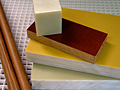
NEMA G-7 Glass Cloth Reinforced Silicone Laminate is composed of a continuous glass woven cloth base impregnated with a silicone resin binder, this grade has excellent heat and arc resistance. It has extremely goo dielectric loss properties under dry conditions and good electrical and good electrical properties under humid conditions, although the percentage of change is high.
Meets MIL-I-24768/17 GSG -
NEMA G-7 - Glass Silicone Rod (Ground from sheet)
NEMA G-7 Glass Cloth Reinforced Silicone Laminate is composed of a continuous glass woven cloth base impregnated with a silicone resin binder, this grade has excellent heat and arc resistance. It has extremely goo dielectric loss properties under dry conditions and good electrical and good electrical properties under humid conditions, although the percentage of change is high.
Meets MIL-I-24768/17 GSG -
NEMA G-9 - Glass Melamine Sheet
NEMA G-9 / Glass Cloth Reinforced Melamine Laminate is composed of a continuous glass woven cloth base impregnated with a melamine resin binder. Melamines are the hardest of all laminates, exhibiting good
dimensional stability and arc resistance. Meets MIL-I-24768/1 GME -
NEMA G-9 - Glass Melamine Rod (Ground from Sheet)
NEMA G-9 / Glass Cloth Reinforced Melamine Laminate is composed of a continuous glass woven cloth base impregnated with a melamine resin binder. Melamines are the hardest of all laminates, exhibiting good
dimensional stability and arc resistance. Meets MIL-I-24768/1 GME -
NEMA FR4 (G-10) - Glass Epoxy Sheet
NEMA G-10/FR-4 / Glass Cloth Reinforced Epoxy Laminate industrial laminate constructed from continuous filament type glass fabric with a non-halogenated epoxy resin binder. This material has high mechanical strength and excellent electrical insulation under both dry and humid conditions. Meets MIL-I-24768/27 GEE-F
-
NEMA FR4 (G-10) - Glass Epoxy Rod (Ground from sheet)
NEMA G-10/FR-4 / Glass Cloth Reinforced Epoxy Laminate industrial laminate constructed from continuous filament type glass fabric with a non-halogenated epoxy resin binder. This material has high mechanical strength and excellent electrical insulation under both dry and humid conditions. Meets MIL-I-24768/27 GEE-F
-
NEMA G-11 - Glass Epoxy Sheet
NEMA G-11/FR-5 Glass Cloth Reinforced Epoxy Laminate produced from a woven fiberglass cloth and epoxy resin binder. It is more heat resistant than G-10/FR-4, offering good retention of mechanical strength at elevated temperatures. Meets MIL-I-24768/28 GEB-F
-
NEMA G-11 - Glass Epoxy Rod (Ground from Sheet)
NEMA G-11/FR-5 Glass Cloth Reinforced Epoxy Laminate produced from a woven fiberglass cloth and epoxy resin binder. It is more heat resistant than G-10/FR-4, offering good retention of mechanical strength at elevated temperatures. Meets MIL-I-24768/28 GEB-F
